Posts written by josefina

I would advice you all to continue doing what I always do – and sort of have instructed you to also take pleasure in – look for signs of Russian literature EVERYWHERE! I found this bumper sticker on a car in downtown San Francisco today: “What would Taras Bulba do?” [«Что бы делал Тарас Бульба?»] Don’t recognize where it’s from? But of course you do! It’s the main character of the novel with the same name «Тарас Бульба» [“Taras Bulba”] by «Николай Васильевич Гоголь» [Nikolai Vasil’evich Gogol’].

«Всему есть предел» [there's a limit to everything], the Russians say. All good things come to an end, people speaking other languages claim. No matter what your native languages might have been, «дорогие читатели» [dear readers], it has been a pleasure for me to have been able to guide you through «сложности и весёлости русского языка» [the difficulties and the gaieties of Russian language] here on the Russian blog since November 2007. As many of you already know, in June this year I left Russia «после 6 (шести) лет» [after six years] of living, studying, working there. Perhaps not a few of you also are aware that currently «я проживаю в США (Соединённых штатах Америки)» [I am living in the USA] and «учусь в аспирантуре университета Беркли» [studying in graduate school at Berkeley]. Thus my reality has changed drastically in the past couple of months – not only have I met a new country, but an entire new world of responsibilities, opportunities and adventures has opened up before me. And no matter how much it makes me sad to say so, I realize that this is «перекрёсток» [the crossroads] of my personal road and the road of the Russian blog.

This is my last «пост» [post – even though some of the nit-pickier might say that this word in Russian should be used only for talking about different kinds of fasts, «великий пост» [lent], for example, and not be confused with texts submitted to blogs of various kinds]. But before I take my final bow, I really want to say «спасибо» [thank you] to all of you, the readers, «мои милые друзья» [my sweet friends], for the essential contribution you have made by way of your comments – as well as guest posts – to this blog. It is true that nothing written ever comes into existence before it is read; and thus only through you can I some day in a very distant future say that once upon a time, when I was a young girl and living in Russia, did I work as a professional blogger… I want to say «спасибо» [thank you] for every time anyone of you have corrected my spelling or my grammar – in Russian as well as in English (I wouldn’t be the kind of writer I am today if it wasn’t for such corrections!) –  and for all the times we have connected on a deeper level through Russia as a country, Russia as culture, Russia as literature, and Russian language as a way of life. It is my innermost wish that you all continue «ваши усердные занятия русским языком» [your zealous studies of the Russian language], and that you learn also to treasure every little step forward.

«Ведь изучению языка нет предела!» [For the study of a language has no limit!]

My life, though located outside of Russia geographically, continues to move inside of Russia on several levels. I’ll continue to teach Russian here at the university; and master more and more while traveling along on the magical mystery tour known as a career «в науке» [in science/academia]… And one day – which now seems so distant and far – I will become that «профессор русской литературы» [professor of Russian literature] I dreamed of becoming when I was a teenager. And one day – who knows, right? – you might send your kids to college and as you do, urge them to take a class in Russian language or literature, and – once again, who knows? – I might turn out to be the one to teach them. I promise I’ll go easy on them and take it one «падеж» [case] at a time…

If there were more time, I would stay on and blog for infinity. They say that there’s always a «выбор» [choice], but in this case «мне и не придётся выбирать» [I don’t even have to choose], for «я уже выбрала» [I have already chosen].

Anyone happen to know if they sell bumper stickers with “What would Tatiana do?” [«Что бы делала Татьяна?»] anywhere? You know, the leading lady from the ‘novel in verse’ by «Александр Сергеевич Пушкин» [Alexandr Sergeevich Pushkin] «Евгений Онегин» [“Eugene Onegin”] is probably my favorite character in all of Russian literature. And to think that I spent almost three years blogging without even mentioning her! Russian literature is indeed an abyss… And with that disturbingly thrilling picture I leave you once and for all, repeating as I go «спасибо!» [thank you!] and «прощайте!» [farewell!]…

It is truly an honor for me – your ‘wonderful hostess’ (I do love compliments like that!) – to introduce this month’s guest blogger: Ryan Perkins! Ryan is a student starting his third year of college level Russian at University of Oregon. He got into Russian in high school when his choir was practicing the hymn «Хвалите Господа с Небес» [“Praise the Lord from the Heavens”] for a state choir championship at the same time as he was learning about the Russian revolution and USSR under Stalin in history courses. He has yet to travel to Russia, having lived out all but a few weeks of his life in the state of Oregon. When Ryan’s not studying Russian, he likes to hang out with friends, or sleep – although he’s been known to forgo sleep for the joy of Russian homework… Being as he is that devoted, it is no big surprise that he’s the one to debut the fascinating topic «о причастьях в русском языке» [about participles in Russian language] here on the blog!

Our wonderful hostess «Джозефина» [Josefina] has graced us with numerous and wonderful posts about Russian grammar, including a wonderful sequence «о шести падежей русского языка» [about the six cases of the Russian language], a post «о русской грамматике по-русски» [about Russian grammar, in Russian], and most recently, a post «о ненастоящих друзьях» [about false friends]. I hope to continue today in her fine tradition of grammatical exposition, and I turn my sights on something many Russian language learners I know are unnecessarily frightened of: «причастия» [participles]!

So, what exactly are participles? They answer the question «какой?» [what kind?/which one?], and decline just like adjectives, but they are not just any kind of adjectives. Participles are adjectives formed from verbs, and there are two major differences between a participle and a “normal” verb (besides how you form them). The first difference: a participle can have a “subject” not in the nominative case. Indeed, the subject of a participle can be in any case. The trick is that the participle, as an adjective, has to match its subject in gender, number, and case. The second difference: A participle cannot be the only verb in the sentence.

We’ll be starting our tour through participles with one of those two participles Russian shares with English, the present active participle.

So what are these used for? Well, for one, you can describe actions by things that might not be the subject of your sentence. Participles allow us (among a host of other things) in Russian language to take the clumsy two-sentence statement “I saw people at the beach. They were swimming and talking,” and make it into something like “I saw people at the beach swimming and talking.” This is just one of the many uses of participles in Russian, but we’ll use it to explain the general idea.

First, we have to first find an imperfective verb. Just like perfective verbs don’t have present meanings when conjugated normally, they can’t have present participles. So, let’s take the verbs плавать and говорить to start with, and use our English sentences from above. The best way to make a present active participle is to start with the 3rd person plural form of a verb, the ending with «-ут»/«-ют» for 2nd conjugation verbs, or «-ат»/«-ят» for 1st conjugation verbs.

Using a verb of each type, we can make a statement like «Я вижу людей на пляже. Они плавают и говорят» [I see people on the beach. They are swimming and talking]. Now, we take off the final «–т», leaving us with the stems «плаваю-» и «говоря. Next, add «–щ» and to those, and attach the ending you need for the participle to agree in case, number, and gender with its subject. In this case, the subject of the participle is «людей» so we need accusative plural endings: «Я видел людей плавающих и говорящих на пляже» [I saw people swimming and talking at the beach].

And even though the name of the participle has the word “present” in it, it’s crucial to understand that it is not necessarily describing a present action. Here they describe action contemporary with the verb «видел» [saw]. The people were swimming and talking when you saw them, and while they might still be swimming and talking at the present moment, you’re just saying what they were doing when you saw them. Since participles don’t have a tense independent of the sentence’s main verb, you need a verb to have a participle.

Let’s look at «примеры из русской литературы» [examples from Russian literature]

«Из «Мастера и Маргариты» Булгакова» [From Bulgakov’s “The Master and Margarita”]:

«…а молодой спутник егопоэт Иван Николаевич Понырев, пишущий под псевдонимом Бездомный» [And his young companion was the poet Ivan Nikolaevich Ponyrev, writing under the pseudonym Homeless].

Participle: «пишущий», from «писать», the third person plural form of which is «пишут».

Here we have the participle «пишущий», in the nominative masculine singular, to agree with the poet, whom it describes. Note also that participles can have more than just a subject associated with them. Ivan Nikolaevich is not just writing, but he is writing «под псевдонимом». Adverbs like this work just like they would if the phrase were «Иван Николаевич пишет под псевдонимом» [Ivan Nikolaevich writes under a pseudonym].

«Тут  приключилась  вторая  странность, касающаяся одного Берлиоза» [Here was the second oddity, which touched only Berlioz].

Participles: «касающаяся», from «касаться», the third person plural form of which is «касаются».

Here we see a reflexive participle. It’s nominative feminine singular, agreeing with «странность». Russian participles are often better translated into English with a relative clause using which or that. Again, the participle can more than just an adjective; here it takes a direct object.

«Он остановил свой взор на верхних этажах, ослепительно отражающих в стёклах  изломанное и навсегда уходящее от Михаила Александровича солнце. . .» [He let his gaze rest on the upper floors, where the glass was dazzlingly reflecting the broken sun forever setting on Mikhail Aleksandrovich…].

Participles: «отражающих», from «отражать», the third person plural form of which is «отражают», and «уходящее», from «уходить», the third person plural form of which is «уходят».

This sentence has two participles, with two subjects. The first, «отражающих», is in prepositional neuter plural, agreeing with «стёклах». The second, «уходящее», agrees with «солнце». This second participle does something bizarre to native English speakers. It comes before the noun it modifies, which is perfectly normal, but it also has an extra phrase stuck in there: “the setting-on-Mikhail-Aleksandrovich sun.”

A sentence «Из «Дамы с собачкой» А. П. Чехова» [from “The Lady with the (Little) Dog” by Anton Chekhov]:

«На пристани было много гуляющих. . .» [There were many people strolling on the pier…]

Participle: «гуляющих», from «гулять», the third person plural form of which is «гуляют».

Here we see the participle without a noun. “An adjective without it’s noun?! Preposterous!” you might say. But Russian does it all the time, «Он – русский» [He’s Russian] being a very common example.

Almost a long time ago now, we had a post called Russian Grammar – «по-русски!» [in Russian!]. It explored what different «части речи» [parts of speech] are called in Russian and also tried to explain «почему [why?] a verb is called «глагол», a noun «существительное» and an adverb «наречие». Today I’m not asking you to remember that «глагол» [verb] comes from the Old Slavonic verb «глаголить» [to speak], «существительное» [noun] is derived from the verb «существовать» [to exist] and that «наречие» [adverb] can loosely be translated as to mean «на речи» [‘on/in speak’]. Today I’m suggesting we do something a little bit different, namely – take a closer look at «русский синтаксис» [Russian syntax]. The first question we all should ask ourselves is: «Что такое синтаксис вообще [What is syntax in general?] Syntax is what is always there for us when we need to find out about the principles and rules for constructing sentences. Syntax is a very helpful invention, especially when studying a foreign language as the rules for proper construction of sentences might differ – A LOT! – from your native language. A sentence in Russian is called «предложение». Don’t confuse this word in today’s context with the standard phrase:

«сделать/делать предложение + кому [to propose + to whom? (lit. To make an offer/sentence to someone)],

for in today’s post «мы будем делать предложения» [we're going to make sentences] of another kind. In today’s post we’re not going to explore the subject of Russian syntax all the way, so to speak, but instead try to create for ourselves a general idea of what this grammatical category can bring into our lives – just in what ways it might be enriching to our devout studies of the Russian language.

Every Russian sentence must usually contain TWO (2) so called «члены предложения» [parts of the sentence]:

In Russian syntax «подлежащее» means SUBJECT.

Think of «подлежащее» [neut. subject] as being derived (and it is!) from the verb «подлежать» [impfv. (with dative) to be subject (to); to be liable to], used in sentences like «товар не подлежит обмену» [the product is not subject to exchange].

In Russian syntax «сказуемое» means PREDICATE.

Because the predicate in a sentence is often the verb, think of «сказуемое» [neut. predicate] as being derived from the perfect verb «сказать» [to say, speak, tell]. And a sentence without a predicate – mostly it is a verb – «не так уж много и скажет» [doesn't really tell/say that much].

An example of a Russian sentence with one «подлежащее» [subject] and one «сказуемое» [predicate]:

«Пётр поёт» [Pyotr sings].

An example of a Russian sentence with one «подлежащее» [subject] and two «сказуемые» [predicates]:

«Алёна поёт и пьёт» [Alyona sings and drinks].

An example of a Russian sentence with two «подлежащие» [subject] and one «сказуемое» [predicate]:

«Пётр и Алёна гуляют» [here: Pyotr and Alyona are partying].

In English syntax, sentences «без подлежащего» [without a subject] are rare and sometimes not even possible. In Russian syntax, sentences with only a «сказуемое» [predicate] in the form of a verb are not rare at all and highly possible. Most often sentences of this kind informs about different weather conditions or other natural phenomena where it is not always too easy to say WHO the subject is:

«Вечереет» ['It is starting to get dark outside’/’the evening is approaching’] – a verb made from the noun «вечер» [evening].

«Похолодало» [‘It has become a little bit colder’] – a verb made from the noun «холод» [cold].

Russian sentences, just like sentences in all other languages of the world, would be rather boring if all they contained were a subject and a predicate. That’s why Russian syntax allows for yet another category:

In Russian syntax, «дополнение» means OBJECT.

Think of the verb «дополнять» [impfv. to expand, enlarge; to amplify, add to] and the adverb «дополнительно» [in addition] and thus the Russian «дополнение» [object] is something you add to a sentence that would’ve been correct and complete even without it – but a bit boring, right?

In Russian syntax, we have two kinds of objects – mainly, and this is true for many other languages as well, so if you remember your school syntax, then I’m not going to loose you as we did deeper into the wondrous world of syntax:

First there’s «прямое дополнение» which means DIRECT OBJECT.

In Russian language «прямое дополнение» [direct object] very often takes on the form of «винительный падеж» [accusative case], like in the following sentence:

«Пётр любит Алёну» [Pyotr loves Alyona].

In this sentence «Пётр» [Pyotr] is «подлежащее» [subject], «любит» [loves] is «сказуемое» [predicate] and «Алёна» [Alyona] is the «прямое дополнение» [direct object]. I don’t know why so many school kids think syntax is boring, difficult and not fun at all? It is really very easy! And what a great way to spend a relaxing Saturday afternoon – dissecting a poem by «Александр Сергеевич Пушкин» [Aleksandr Sergeevich Pushkin] «на члены предложения» [according to parts of the sentences]…

Secondly, there’s «косвенное дополнение» which means INDIRECT OBJECT.

In Russian language «косвенное дополнение» [indirect object] is often expressed by the noun – if it is as noun – taking the form of «дательный падеж» [dative case]. This isn’t ALWAYS the case, though, so be sure to be aware of this rule not always applying. But in the following sentences it is:

«Алёна наливает вино Петру» [Alyona pours Pyotr wine].

In this sentence «Алёна» [Alyona] is «подлежащее» [subject], «наливает» [pours] is «сказуемое» [predicate], «вино» [wine] is «прямое дополнение» [direct object] and «Петру» [(to) Pyotr] is «косвенное дополнение» [indirect object]. Did you all follow that?

Of course, Russian syntax is much more complicated – deep, if you’d like – than what I have tried to illustrate above. There are plenty of more difficult constructions of sentences in Russian, and a whole lot more for us to discuss in the future. But I think we’ve done enough for one day today. And so as not to leave you simply longing for more, try and pick these two sentences apart and tell me what’s subject, predicate and direct/indirect objects in the comments:

1. «Хорошо (yes, it is a tricky one!)

2. «Мне нравится классическая музыка» (yeah, this is tricky too…)

Want people to know «ты владеешь русским языком» [you speak Russian] even when you’re not within the Russian Federation? Wear a «Чебурашка» ['Cheburashka'] on your purse – like I’m doing here in San Francisco – and you’ll see the proverb «русские всегда рядом» [Russians are always close/around] is true indeed! Russians in the USA always talk to me when they see my «Чебурашка» ['Cheburashka'] – don’t knock it until you’ve tried it!

«В северной Калифорнии» [in northern California] where I’m presently living «не купить Ленина в шапке в стиле Санта-Клауса» [(one cannot/it is not possible) to buy Lenin with a hat in the style of Santa Claus]… This picture is yet another nostalgic trip down Ural Memory Lane – the «я люблю Урал [I love the Urals!] in the background sort of gives it away, I guess…

«Привет всем!» [Hi everybody!] Excuse me for being so informal; I should’ve probably chosen the «здравствуйте!» [hello!] variant of greeting you instead, «дорогие читатели» [pl. dear readers], but I didn’t so let’s just get this party started. In case we haven’t met before – if you’re new to this blog, for example, or began reading it without being properly introduced to the two women behind it – one of them is me and my name is «Джозефина» [Josefina]. If you’ve been reading this blog for some time now – maybe ever since I started writing for it in the fall of 2007? – then you probably know that «раньше я жила в Екатеринбурге» [before I lived in Yekaterinburg] and perhaps you even remember somewhat vaguely that «всего я жила 6 (шесть) лет в России» [all in all I lived six years in Russia]. If this is all news to you, that’s alright. I may have been forced to leave Russia this summer due to being accepted «в докторантуру в Беркли» [to graduate school at Berkeley], but because I study (and spend almost all of my time) «на факультете славянских языков и литератур» [at the Department of Slavic Languages & Literatures] I am in a highly privileged position: even here I am always surrounded by Russian language, Russian people and Russian culture – despite ‘officially’ residing «в Соединённых штатах Америки» [in the United States of America]. Are you also a student of Russian language or literature (or both!) at some department in a university? What university? In what country? «Давайте будем дружить университетами!» [Let's be friends 'through our universities' or 'as universities'!] How long have you been studying Russian language? I would love to find out more about where our «дорогие читатели» [pl. dear readers] are learning Russian.

But now for something completely different! So, what was the biggest shock for me coming to the USA after living in Russia for so long? Well, obviously I was shocked by many things. For example, American grocery stores often carry only one single brand of «гречка» [buckwheat] and American public restrooms never lack «туалетная бумага» [toilet paper]. This was all shocking to me after living long as well as prospering «в Российской федерации» [in the Russian Federation]. This one can get used to rather quickly. What I am still getting used to is how Americans tend to say ‘excuse me!’ and ‘sorry!’ all the time. They say it even though they’re only ALMOST bumping into you. Sometimes they say it while walking past you in the store or on the street. In Russia you’d be surprised if someone who ALMOST bumped into you on the street said «простите [(formal or when addressing more than one person) excuse me!]. I’d even be surprised in Russia if a stranger did bump into me on the street and then turned to me to exclaim with feeling: «извините [(formal or when addressing more than one person) pardon me!]. Does this mean that Russians are – as many a foreigner has thought them to be due to situations like the one described above – a rude people? I don’t think that’s necessarily true. I think it goes deeper than being simply rude or impolite. In general, people do not talk to strangers in Russia (see, it looks like they paid attention to their mothers when they said: “Don’t talk to strangers!”). Usually Russians do not strike up random conversations just with anybody on the street or in the store or in a restaurant. Does this mean that Russians are cold, reserved and not communicative in general? I prefer to look at it as Russians are more introvert than extrovert. In Russia people do not assume that you’re interested in hearing about their day, their week, their year or their life simply because you happen to be next to them in line at the grocery store or also waiting for that same bus. On the one hand, I do miss the Russian ‘rudeness’, i.e. being introvert – but on the other, it is refreshing to hear ‘I’m sorry!’ from somebody, for example, stepping all over your toes.

Let’s further explore how to say ‘sorry’ in Russian, for the expression ‘when in Rome…’ doesn’t always have to apply to everyone and everywhere. If you come from a culture where excusing yourself is imperative, then bring that tradition with you when you travel. Saying you’re sorry has never hurt anyone, after all. I come from a country (Sweden) where one should always say «спасибо» [thank you] whenever possible – ultimately, it should be repeated in every sentence uttered (okay, so that’s me being a teeny tiny bit ironic). This is not common in Russia or Russian language. Yet I kept on doing it during all the six years I lived there…

The Englishsorry’  can be translated into three different concepts in Russian:

1. (feeling sympathy) «жаль» with which you can say both «мне жаль» [I am sorry] and more specifically «мне её жаль» [I'm sorry for her] – when needed.

2. (feeling regret) «сожалеть» [impfv. to be sorry] by way of which you can express yourself in the following manner: «теперь я сожалею, что сделала это» [I am sorry now that I did it].

3. (expressing one’s apologies) «простите!» [(addressing one person formally or more than one person) I’m sorry!] or «прости [(addressing one person informally) I’m sorry!] is what you should say in Russia when bumping into somebody. Since you usually aren’t informal with strangers on the street in Russia be sure only to use the «простите!» variant. Just so you make sure not to offend people you don’t know – and who could potentially become close friends with you and perhaps take you skiing in «Сочи» [Sochi] next winter if you play your cards right.

When you want to say ‘excuse me!’ in Russian language, you can either use «простите!» and  «прости – as shown above – or make use of «извините!» (for formal address or plural) and «извини (for singular and informal) which both translate into English as ‘excuse me!’ or ‘pardon me!’.

From the verb «простить» [pfv. to forgive] the neuter noun «прощение» is derived. It has two connotations that can both be used to say you’re sorry in Russian: 1. forgiveness: «просить прощения у кого-нибудь» [to ask for someone’s forgiveness] and 2. pardon: «прощу прощения!» [I beg your pardon!].

Also from the verb «извинить» [pfv. to excuse, pardon] a neuter noun is derived: «извинение». It has three connotations in Russian and can indeed too be used to express how sorry you are in the following manner: 1. apology: «прощу извинения!» [I’m sorry!]; 2. pardon: «просить извинения у кого-нибудь» [to beg someone's pardon]; 3. excuse: «это не извинение» [that's no excuse].

And last – but not least – we have a reflexive verb made from the imperfect «извинять» [to excuse, pardon]: «извиняться» [impfv. to apologize] + «перед кем?» [to whom? (with instrumental case)]. How should we use it in a sentence then? How about this:

«Я извиняюсь перед вами, что не придумала хорошей концовки для этого поста…» [I apologize to you that I didn’t come up with a good ending for this post...]

Can it really be true that we’ve saved the best for our final, third, part of “Same-Same but Different”? After two posts – one on «омонимы» [homonyms] and another about «омофоны» [homophones] – we made it all the way to the truly troubling and trickiest of them all: «омографы» [homographs]. Here and now is when not only your intuition will be put to the test, but also your ability to «запоминать» [impfv. to remember, to make it a point to remember; to memorize (it’s perfect ‘friend’ is «запомнить»)] words that are spelled the same but pronounced differently. The last part is imperative because these words differ in meaning depending on how you pronounce them. I’m sure everyone already knows and agrees with me that «знать, на какой гласный падает ударение» [to know which vowel is stressed (lit. ‘to know on what vowel the stress falls)] in Russian words is «один из самых сложных моментов русского языка»  [one of the most difficult moments of Russian language]. «Омограф» [homograph] comes from Greek and means ‘written the same’. Russian language – rich as it is in several other ways as well – has many pairs of homographs. A large number of them are the results of simple morphological coincidence; though it of course would have been much more «любопытно» [curiously; also: interesting] for us had there been more to investigate behind them. Today’s post will only include a very «маленькое количество омографов» [small amount of homographs] to illustrate this complicated – for non-native speakers, that is – phenomenon.

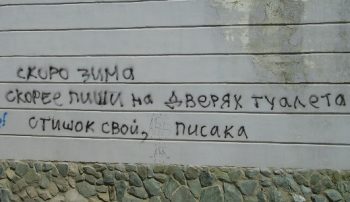
Found on a wall in Yekaterinburg during the summer of 2007 (can you guys imagine how long I’ve been searching for a reason to post this picture here?!): «Скоро зима. Скорее пиши на дверях туалета свой стишок, писака» [Soon (it will be) winter. Hurry up and write (or: pee – depending on where you put the stress) your little verse on the walls of the toilet, scribbler (also: poor writer, hack writer)].

The highly imaginative and kind of profound graffiti above probably needs to be explained. First of all, it uses two so-called ‘negative’ diminutives derived from neutral nouns: «писака» [both fem. & mas., poor writer, hack writer, scribbler] from «писатель» [mas. writer] and «стишок» [little verse, bad poem, poor quality poetry] from «стих» [verse; pl. poetry, poems]. But it is also partly built around the homographs «писать» [impfv. to write] and «писать» [impfv. to piss]. Many foreigners in Russia have confused these two verbs with each other and made a fool of themselves; just as many foreigners will make the same mistake and thus also a fool of themselves in the future. Partly this is because most of us aren’t taught that the «писать» [to piss] way to pronounce this verb has a WHOLE OTHER meaning and so we don’t know how important it is to pronounce it right, i.e. «писать» [to write].  But only in infinitive form – and I’m guessing also in imperative because of the graffiti above – are these two verbs true homographs. As soon as you start putting them in first person singular present time, you’ll come to see that it is not really as easy to confuse them with each other anymore:

«Писать» [impfv. to write] becomes «я пишу» [I write].

«Писать» [impfv. to piss] becomes «я писаю» [I piss].

The same is true for all other forms of these two verbs in present tense, like in second person singular for example:

«Писать» [impfv. to write] becomes «ты пишешь» [you write];

«Писать» [impfv. to piss] becomes «ты писаешь» [you piss].

Of course it would be embarrassing to realize the next day that you told a Russian «мне нужно писать» [I have to pee (or: I need to pee)] when what you really wanted to inform them of was «мне нужно писать» [I have to write (or: I need to write)]. But I’m certain they’ll get over it. Let’s consider another sometimes annoying hompgraph: first person singular in present tense of both «платить» [impfv. to pay] and «плакать» [impfv. to cry] is written like «плачу». Say you asked a Russian girl/boy out to dinner, they said yes and everything has been going great up until the moment that you get the bill on the table. How do you pronounce the sentence «я всегда плачу» so that it means ‘I always pay’ and not ‘I always cry’ (unless that’s what you want to say)?

Your date will be impressed with your «ЩЕДРОСТЬ» [fem. GENEROSITY] if you say….

«Я всегда плачу» which is 1st person singular of «платить» [impfv. to pay].

Your date will be impressed with your «ЧУВСТВИТЕЛЬНОСТЬ» [fem. SENSITIVITY] if you say…

«Я всегда плачу» which is 1st person singular of «плакать» [impfv. to cry]

Has anybody else ever walked up to the counter in a Russian store and asked for «мука» [torment], when what you really needed in order to bake cookies was «мука» [flour]? That happened to me on a regular basis. In fact it happened so much that I would think I was always saying the word wrong even when I got it right… Has that ever happened to you?

Here’s a tiny little list of other homographs worth memorizing:

«атлас» [atlas];

«атлас» [satin].

«замок» [castle];

«замок» [lock].

«потом»: instrumental case singular of «пот» [sweat].

«потом» [(adverb) then].

«уже»: short comparative form of «узкий» [narrow], i.e. meaning ‘narrower’.

«уже» [already].

Back to the Top