jakt i Norge

Posted by Kari

Hunting in Norway. 

My kjæreste (boyfriend) and I took our hund out yesterday pheasant (fasan) hunting.  Because our høst has been so kald with so much regn, most of the corn fields have not been harvested yet, and thus, it is difficult to hunt for fugler (birds) because they are protected by the corn.  We didn’t even see one fasan or any kind of bird that is legal to hunt, so it was quite disappointing.  I don’t have a hunting license and I don’t know that much about it, so for now, I just go along to be a spotter. 

Being out yesterday got me thinking about jakt i Norge.  I don’t recall any of my friends in Norway being jegere (hunters), but I know some of my family members are.  I’ve done a little research on jakt i Norge that I’d like to share with you in case any of you are jegere or just curious about the topic and perhaps how reglene (the rules) and reguleringer (regulations) differ from your hjemland (home country).   

For starters, I think the age requirements for jakt i Norge and in the state that I live in, Minnesota, are interesting.  In Minnesota, a child can be certified and begin hunting at the age of 11 (which is before junior high).  In Norway, a child can take the proficiency test at age 14, but cannot begin hunting until age 16.  At age 16 in Norway, it is legal to hunt for small game and to trap (all but gaupe, or lynx, which one must be 18 to hunt).  Large game hunting is permitted at 18 years of age.  The age difference for jakt i Norge and the United States is not unlike the age difference pertaining to consuming alkohol, being able å kjøre (to drive), and participate in a krig (war) in the two countries.  In the U.S., a child is allowed to shoot a gun 10 years prior to being able to consume alkohol, kjøre en bil (drive a car) 5 years before he/she can consume alkohol, and kjempe i en krig (fight in a war) 3 years before he/she can consume alkohol.  In Norway, the procession is quite different-one can gå på jakt and drikke alkohol 2 years before one can kjøre en bil or kjempe i en krig. 

Enough political thought and more about hunting…

Similar to the United States and I’m sure many other countries, one must pay a fee to obtain a license to hunt.  In Norway, as long as the jeger has permission, he/she can hunt on government property, state common land (a feature of southern Norway, from Nord-Trøndelag to the south and then also in northern Norway), and private property.  As far as what kinds of dyr (animals) people can hunt, it all depends on one’s status as a citizen of Norway.  Foreigners can hunt in Norway, but there are more regler and reguleringer that apply to non-nationals that live in Norway.  The Directorate for State Forests and Land and the Municipal Common Land Boards are responsible for hunting and processing applications.  You can find more information if you consult these sources.

Lastly, I would like to mention dyr that are commonly hunted in Norway:

rype-ptarmigan/grouse                               gjess-goose

elg-moose                                                    hare-hare

hjort-deer                                                    gaupe-lynx

villrein-wild reindeer                                  ulv-wolf

bjørn-bear                                                    vadefugler-wading birds

sjøfugler-sea birds                                      bever-beaver

and the list goes on….

happy jakt!


Â


Halloween i Norge

Posted by Kari

Halloween in Norway.  Do nordmenn celebrate Halloween?  The answer is yes, but not to the extent that Americans do, and they do it slightly differently.  It was not until very recently that the trend caught on in Norway to celebrate Halloween.  Actually, there is an interesting chart in an article in Aftenposten online that shows the increase of coverage of Halloween in Norwegian newspapers.  In 1997 there were 15 comments or discussions about Halloween and in 2008 there were 433.  It was only a matter of time before the spooky day became popular. 

This year the most popular kostymer (costumes) are edderkoppdrakt (spider wear) and djeveldrakt (devil wear).  There are definitely barn (children) who dress as non-scary things, such as prinsesser or other Disney karakterer.  The following site provides a guide to kostymeutleie (costume rental) places in Oslo: http://oslopuls.aftenposten.no/shopping/article88457.ece 

So what do barn say when they ring a doorbell in hopes of godteri (candy)?  They don’t say “trick or treat,” they say “knask eller knep?”  I have never experienced Hallowen in Norway, but apparently it is not uncommon for barn to actually play a knep or even vandalize something if they don’t get a knask. In the U.S., “trick or treat” is just what you say when you ring a doorbell and someone answers.  Most people will simply smile and give you a treat.  I actually don’t remember ever not getting candy or being asked to do a trick.  The only thing I ever got mad about was getting an eple (apple) or something else healthy for a treat. Halloween is all about sugar!

So if you are going out for Halloween in Oslo tonight, it sounds like there are plenty of fester (parties) and feiringer (celebrations).  There is even an event up at the lake that I lived by in Oslo-Sognsvann.  There is a huge bÃ¥l (bonfire) up by the lake where you can roast pølser after you walk through the dark forest to get there.  You can take a trip to the Historisk Museum to decorate a skull.  You can go to Akershusfestning and hunt for ghosts or listen to live musikk inspired by spooky things.  There is plenty to choose from in Oslo to feire Halloween tonight.Â


norske navn

Posted by Kari

Norwegian names (notice there is no “er” ending on the indefinite plural “names” because navn is a one-syllable “et” noun).  It’s always for me to learn about names and their origins or what name something equates to in my own language.  Names are kind of funny things, right?  It seems people can always come up with new names out of the 26 letters in the English alphabet.  Many names we might think are new are actually old names from a different culture.  Such as Elias, which equates to Elijah, a name found in the Bible.  Or Filip, which you might guess is Phillip.  There are many names that look familiar, but sound much different (i.e. Elisabet-Elizabeth look very similar but the Norwegian Elisabet is pronounced “Ay-lee-sah-bet”).

The following is a list of names and their equivalents that look, but maybe don’t sound the same in English:

Edvard-Edward                                     Anders-Andrew                             

Daniel-Daniel/David-David (the “a” is and “ah” sound in Norwegian)

Brigitta/Birgitta-Bridget                     Aksel-Axel (again the “a” is prounounced “ah” in Norwegian)

Joakim-Joachim                                    Johanne/Johannes-John�                     

Kjersti (pronounced “Chair-stee”)-Christi/Kristi                Lars (pronounced “Larsh”)-Laurence

Mikkel-Michael                                    Morten-Martin                            PÃ¥l (pronounced “Pole”-Paul)

You get the picture…

And now, let’s look at norske navner that have meanings

Trygve-a name derived from an Old Norse word meaning “trustworthy” (trygg means “safe”)

Viggo (like Viggo Mortenson)-derived from an Old Norse word meaning “war”

Solveig-derived from Old Norse words for “sun” and “strength”

Olaf-derived from Old Norse word meaning “ancestor” or “descendent”

Helge-derived from Old Norse word meaning “holy” or “blessed”

Leif-derived from an Old Norse word meaning “descendent” or “heir”

Magnhild-derived from Old Norse words meaning “mighty/strong” and “battle”

Arne-derived from Old Norse short term for “eagle”

Bergljot-derived from Old Norse words meaning “help/save” and “light”

Halstein-derived from Old Norse words meaning “rock” and “stone”

And you get the picture…

I love norske navn.

�


Norge i et nøtteskall

Posted by Kari

Norway in a nutshell is a fantastic way to see Norway’s natural beauty.  If you ever get the chance to do it, I highly recommend it.  I took the tour with my mother and brother over 5 years ago.  The weather wasn’t the best, but I can still say I have never seen anything more beatiful in my life than I did that day on the tour. 

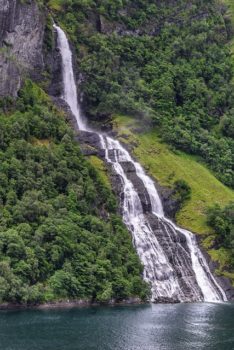
Norge i et nøtteskall takes you through the breathtaking country by local train, regional train, tourist boat, and bus.  Some of the highlights include the Bergen railway, the Flåm railway, Nærøyfjord, Aurlandsfjord, and Stalheimskleiva.�  You see mountains, rivers, waterfalls, and beautiful fjords along the way. 

The Bergen railway is northern Europe’s highest altitude railway; it endures harsh weather for part of the year and thus requires extremely skilled technical expertise to maintain it and provide a safe, enjoyable experience for all who use it to get between Oslo and Bergen. 

The Flåm railway was one of my favorite parts of the trip.  It takes passengers from the mountain station of Myrdal down to Flam.  It is a fairly short leg of the trip, but the train travels slowly and makes several stops to really get good views. 

Once the train reaches FlÃ¥m, you have some free time to walk around until you board a tourist boat which sails through the Aurlandsfjord and into the Nærøyfjord, one of the narrowest fjords in Europe and also on UENSCO’s World Heritage List.  This part of the trip is pretty magical with the mountains surrounding you, views of traditional, picturesque Norwegian farms (if you’re lucky, you might see seals basking on rocks and goats grazing).

After the boat trip, the journey takes you by coach up the curvy, steep roads of Stalheimskleiva.  I remember looking out the bus window and seriously wondering if it would be possible to get up and down these narrow, steep, and extremely bendy turns.  Kudos to the bus driver.  This is the leg of the trip where you see waterfalls, including Stalheimsfossen and Sivlefossen.  From Voss, you can either go to west to Bergen or east to Oslo. 

The trip is not too expensive and it is completely worth it for what you get to see.  Before I sign off, I forgot the most interesting part.  At one of the waterfalls that we stopped at, a hulder emerged from the waterfall and was singing beautiful music.  She had a red dress on and donned a cow’s tail.  Huldrer are seductive forest creatures.  Needless to say, my 20 year old brother was impressed.  I had never before seen a cow woman pop out of a waterfall and belt out what sounded like magic fairy music.Â


Sterke verber

Posted by Kari

Strong verbs.  Unfortunately, as I mentioned previously, you cannot tell by looking at a verb if it is sterk or svak.  Additionally, there isn’t exactly an easy way to learn the past tense of sterke verber; memorization is the only answer.  Unlike svake verber, sterke verber do not follow any kind of pattern.  Isn’t it interesting to think about how all of these words came to be?  Did someone decide that there were going to be 2 different ”classes” of verbs and that one would follow a pattern and the other class wouldn’t?  The history of the evolution of the Norwegian language probably has enough content for another dozen posts, so I’ll end my curiosity there for now.  Back to sterke verber…

The following is a list of sterke verber in the infinitive and the past tenses (as with svake verber, sterke verber receive an ‘r’ after the stem in the present tense…more on this later).  Notice the forskjeller (differences) between the infinitiv and the preteritum-lots of vowel changes in the stem.

INFINITIV                          PRETERITUM

gå (go)                                gikk

sitte (sit)                            satt

se (see)                              så

bli (become)                      ble

drikke (drink)                    drakk

få (get/receive)                  fikk

skrive (write)                     skrev

står (stand)                        stod

synge (sing)                       sang

være (be)                            var

forstår (understand)           forstod

Again, there is no rhyme or rhythm to this sterk verb madness.  The only thing you might have noticed that seems like a pattern is with the words stÃ¥r and forstÃ¥r, in which the vowels in the stems both changed to ‘o’ and there is a ‘d’ at the end in the preteritum.  If the stem is the same (in this case, stÃ¥r), chances are the change will be the same from infinitiv to preteritum.