
Guest Post by Heather Witten, a Spanish teacher at Elizabeth High School in Colorado, where she has been on the CCFLT (Colorado Congress of Foreign Language) Board for the last 4 years. She has been flipping her Spanish class for the last 7 years and has written a chapter in the book “Flipping 2.0” describing her experiences as a flipped classroom teacher. You can also follow her classroom experiences and reflection on her blog.

When I began using the flipped class, I thought the best part was that I would not have to directly teach grammar. The next year, I was sure that being able to allow students to practice listening exercises at their own pace was the best part of the flip. The following year, the best part of the flipped class was being able to group students by ability and better structure their learning.
Since moving to the flipped class, I have stopped using my textbook and rely on as much authentic material as I can find. Students are given one or two grammar videos to take notes on prior to class. This material is then incorporated into the activities that we complete in class, like circumlocution games, drawing activities, small group conversations, and reading short novels (TPRS).
It has occurred to me that through my years flipping my class, the very BEST thing that happened was that the students became the center of the classroom universe. This has taken many forms and has looked different as time has gone by, but the fact remains it is the student-centered aspect of the flipped class that has made all of the difference in my teaching and in their learning.
Keep in mind that the freedom that the flipped class gives the students to control the class can be overwhelming at first. Teachers need to provide parameters, check points and direction for students to be successful in the flipped classroom. Students can often fall into the trap of thinking they have “free-time” when given the opportunity to work on classwork individually. Teachers must guide students carefully at the beginning of the flipped class implementation in order to clearly define how class time is structured.
The student-centered class is the best way for students to understand their learning needs and increase their proficiency in the language. By continuing to keep the focus of the class on them and giving students the freedom to make the class theirs through their choices keeps the class relevant and inspires students to learn. That is what we, as language teachers, strive for.
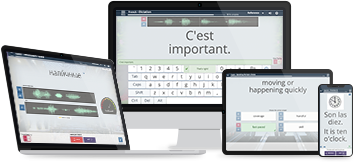
Help students build vocabulary and practice pronunciation with self-guided lessons in Transparent Language Online. Then you can spend class time putting that new knowledge to good use.
Learn more about Transparent Language Online for Education.

