Spanish is the most widely spoken Romance language
in terms of the number of speakers and the number of countries which claim Spanish as the official
language. Approximately 275 million people in 19 countries ranging from Spain to Costa Rica speak Spanish. Spanish
is also spoken in the Balearic Islands, the Canary Islands, communities in the United States of America, and
parts of the west coast of Africa. A variation of the Spanish language, called Ladino, is also spoken in
Turkey and Israel by descendents of Jews who were expelled from Spain in 1492.
Much of Spanish vocabulary stems from Latin, which was introduced to the Iberian peninsula in
the 3rd century during the Roman conquest as a dialect, Castilian. During the Christian
reconquest of the 15th century, all the kingdoms of Spain were united and the language of
Castile became the dominant dialect. Castilian Spanish is spoken in Spain today. Castilian Spanish and Latin American Spanish differ from region to region.
Latin American Spanish, in particular, has evolved since colonization. For example, peach is melocotón
in Spain and durazno in Latin America. One notable difference is the inclusion of
words from the indigenous languages of Latin America into modern Spanish vocabulary.
Many of the words that begin with
"f" in other Romance languages begin with an "h" in Spanish (hilo, thread;
hijo, son). Another distinction in the Spanish language is the Moorish influence. Many Spanish vocabulary words beginning with "al-" are of Moorish descent (alfombra, rug; alfiler,
pin; almohada, pillow).
English words that come from Spanish vocabulary include cargo, siesta, hacienda, patio,
armada, canyon, plaza, rodeo, adobe, vanilla, tornado
and embargo.
While you are learning Spanish vocabulary, you may see words that seem familiar. However, don't assume that a Spanish word always means exactly what you think it does! For example, the following words look like English words, but
don't mean the same things: If you tell someone you are embarazada, you are really telling them
you are pregnant! If you want to go study at the librería, you are headed for the
bookstore! If you'd like some nice fábrica for a new dress, you'll be wearing a
factory!
As you learn Spanish, you will learn two ways to address someone,
familiar and formal. The familiar form of you is tú and verbs used with tú
are conjugated in the 2nd person. The formal form of you is usted and verbs used with usted
are conjugated in the 3rd person. The familiar form is used with friends or with people who
are younger you. The formal form is used when you speak Spanish with elders or people you don't know.
One marked difference between Castilian Spanish and Latin American Spanish is the use of vosotros
and ustedes. Vosotros, used only in Spain, is the informal plural form of you and the
corresponding verb is conjugated in the 2nd person plural. Ustedes is the formal, plural
form of you. However, in Latin America, ustedes is used for both the formal and informal address
for 2nd person plural but the corresponding verb is conjugated in the 3rd person plural
form. For example, "Vosotros estáis felices " and "Ustedes están felices"
(You are happy) mean the exact same thing, but the former would only be used in Spain.
While an English speaker who is learning Spanish may recognize some Spanish vocabulary, there are several things that can trick an English speaker trying to
learn Spanish grammar. For example, unlike English words, Spanish
nouns, adjectives, pronouns, and articles have a gender assigned to them. For instance,
casa (house) is feminine
and
libro (book) is masculine;
bonita (pretty) is feminine and
bonito
(pretty) is masculine. This concept can be difficult to get used to because it simply does not exist
in English.
Spanish is pronounced phonetically. However, Spanish pronunciation varies
from country to country. This difference is especially prominent in the pronunciation of the letters
"z", "s", "c", "ll" and "y." The Spanish pronunciation of certain letters can also be difficult for those learning to speak Spanish. The most notable
sound that is difficult for English speakers learning Spanish is rr, which is trilled. The letters b
and v are indistinguishable. The letter h is silent.
In the Spanish language, there are two verbs for "to be, " ser and estar. Ser
is used for things that are permanent, identifying yourself or others, and describing
occupations. Estar is used to describe more temporary things and to indicate
location. For example, Elena es actriz (Elena is an actress) and ¿Dónde
está Elena? (Where is Elena?) use ser and estar, respectively.
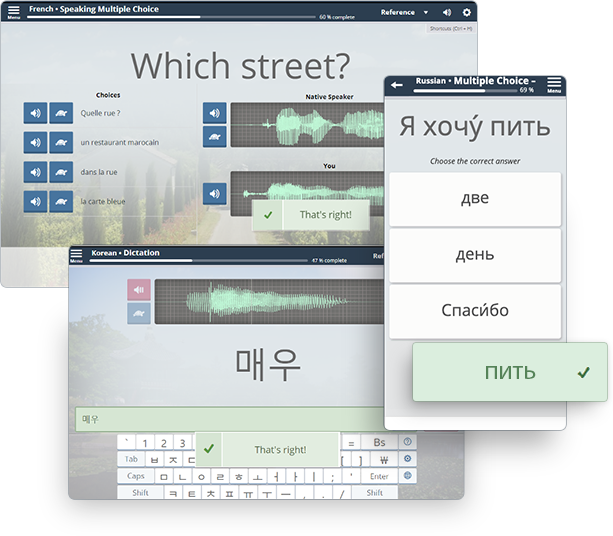
Regular practice is important to learn to speak Spanish well. That's why good
Spanish software programs can be so useful. It's easier than ever to learn Spanish and to begin to speak Spanish with the language
resources and Spanish language software from Transparent Language. With
SpanishNow!,
Before You Know It,
KidSpeak,
PDQ, and our other language learning products, you will speak Spanish, learn Spanish vocabulary, understand Spanish grammar, and master Spanish pronunciation quickly. Plus, our Spanish translation software, EasyTranslator, will help you translate Spanish to English and translate English to Spanish. Best of luck with your Spanish language learning!