Logo
Live chat by BoldChat
McAfee Secure sites help keep you safe from identity theft, credit card fraud, spyware, spam, viruses and online scams
Call Toll Free: (888) 245-1829 Contact Us Customer Service Tech Support Guarantee
Learn Hungarian Language
Hungarian Learning
About Hungarian
Hungarian Products
Games
Quizzes
Resources
Learn Hungarian with Free Software Downloads

Mailing List


Exclusive offers.
Product highlights.
Language updates.
Join our mailng list today!


Overview of the Hungarian Language

Hungarian or Magyar (pronounced "Mawdyar") is the mother tongue of the inhabitants of Hungary, as well as millions of people in neighboring countries-- mostly Romanian Transylvania to the East, Slovakia to the North, and Croatia and Yugoslavia to the South. There are also Hungarian speakers scattered around the world in various emigrant communities, especially in North America and Australia.
 
Modern Hungarian has eight major dialects, which permit a high degree of mutual intelligibility. Two of the dialects, Central Transylvanian and Székely, lie almost entirely within Romania, and the remaining six dialects radiate outward into neighboring countries. Three dialect areas join near Budapest, the nation’s capital.
 
Hungarian is an Ugric language of the Finno-Ugric subgroup of the Uralic language family. Originally from a large region in Central European Russia, Finno-Ugric peoples started migrating in different directions around 3000 BC. In the first centuries of the Christian era, the Ugrians began a slow migration westward towards present-day Hungary. They arrived in the ninth century, making contact with the Bulgar Turks and the Khazars. In this way, the largest Finno-Ugric nation came into existence. Constituting an enclave surrounded by speakers of Germanic, Slavic, Romanian and Turkic languages, Hungary was linguistically a very isolated nation. The closest related languages are the Ostyak and Vogul languages of Siberia, spoken in a region more than 2,000 miles away.
 
Formal and Informal Address in the Hungarian Language

In Hungarian, the given name is put after the family name of a person: János (John) Kis (Little) becomes Kis János (John Little). The title is put after the last name: úr (Mr.) Kis (Little) becomes Kis úr (Mr. Little). When addressing a woman, the title is tagged onto the last name in form of a suffix: -né (Mrs.) Kis (Little) becomes Kisné (Mrs. Little).

Hungarian Vocabulary

English words of Hungarian origin include goulash (a stew made with beef or veal), paprika (a seasoning made from sweet red peppers), coach (named after the village of Kocs, where carriages were invented and first used), and saber (a cavalry sword).
 
The novice Hungarian learner may be tempted to associate new words with English words that they resemble, but beware! There are some false friends that can get you in trouble. If you say, "May I have the bolt and the arc?" you are actually asking for the store and the face. Don’t say, "I’m going to take a nap," unless your real intention is to steal the sun! Some other false cognates are dug (to stick, to put), be (into, in), fed (to cover), fog (tooth, hold, take), font (pound), ad (give, present), mind (all), mint (as, like) and most (now, at present).

Hungarian is not related to the Indo-European languages which surround it. That explains why it is very different in vocabulary, even though it has borrowed at times from Slavic, Germanic, and Romance languages, as well as from Turkish and Iranian.
 
Hungarian Grammar

Hungarian differs greatly from the Indo-European languages in grammar as well. The grammar contains a number of complex features, the most outstanding being an elaborate system of 20 cases to express prepositional meaning. Yet there is no gender in Hungarian-- a grammatical feature that English speakers struggle with when learning other European languages.
 
The usual method of marking grammatical categories (e.g. tense, person, number, and case) is by adding suffixes to a root word. The choice of suffix is governed by the vowel harmony of the root. For instance, the suffixes -ban and -ben both mean "in." A word like ház (house) requires -ban, whereas the word kéz (hand) calls for -ben because the vowels in the word stem and the suffix harmonize.
 
Hungarian uses the Latin alphabet, so after learning a few simple rules, one can read the printed letters. Pronunciation is also easy, especially compared to such neighboring languages as Czech, German, and Russian. The stress is always on the first syllable of a word.
 
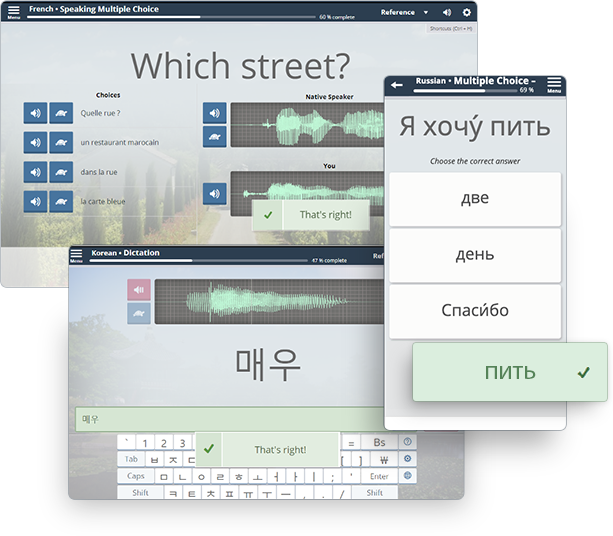
With the help of good Hungarian software programs, you'll be able to immerse yourself in Hungarian. Plus, native speaker sound will help you hone your listening abilities. You will be understanding and speaking Hungarian in no time!

Hungarian Byki Deluxe


Home | About | Products | Languages | Store | Partners | Government | Contact Us | Customer Service | Technical Support | Privacy Policy | Terms and Conditions

If you have comments about this language learning site, language software, or ways to learn languages, please contact us.
©2009 Transparent Language. All Rights Reserved. www.transparent.com
Please also visit our language websites:
Arabic | Chinese | Dutch | French | German | Hebrew | Italian | Japanese | Latin | Polish | Portuguese | Russian | Spanish | Swedish