Posts tagged with "russian cases"

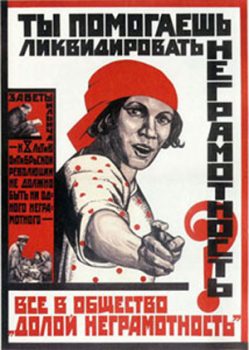
An old poster commands: “You are helping to liquidate illiteracy! All join the “Down with Illiteracy” society”.

If you are looking for entertaining and helpful takes on some of the stickier problems of Russian grammar, then this post is for you. NOTE: not all the posts mentioned below were written by me. In fact, I wrote just a tiny portion of them. So if you leave comments on those posts (with links in italics), your comments might not appear right away and might take a couple of days to be approved.

Over the years we collected quite a few posts on this blog, 472 to be exact. A few of these posts are grammar posts. In case you don’t like digging through the archives and don’t have time to search by keywords, this is a round-up of our grammar posts:

As a warm-up, read a quick review of «части речи» [parts of speech]. Once your grammar juices are flowing and you are ready, dive right in!

One part of speech that Russian language doesn’t have is «артикль» [article]. How do Russians get by without all those “a/an” and “the”? Quite famously, thank you very much! Seriously, find out how to make your Russian friends understand that you’re talking about THIS blog and not about another blog.

Russian verbs can be very confusing and time-consuming to learn. The «глаголы русского языка» [Russian verbs] overview post might help you get oriented in the verb maze.

Once you’re done with the overview, you might want to start digging deeper. If you always thought Russian verbs of motion to be tricky and confusing, this post on «глаголы движения» [verbs of motion ] is for you and so is this one.

Tired of «глаголы» [verbs] yet? If not, then I have some good news for you. Russian verbs don’t just have the three tenses, but two aspects as well – perfective and imperfective.

Another topic that is difficult for many Russian learners is that of «склонения» [the Russian cases]. We’ve tried to demystify and simplify them through the years:

«Именительный падеж» [Nominative case] – «так просто и полезно» [it’s so easy and useful]

«Родительный падеж» [Genitive case] is such a trouble-maker that it required 3 posts to cover it – Part 1, Part 2 and Part 3.

«Дательный падеж» [Dative case] – lots of examples in the post make this case an easy one to crack.

«Винительный падеж» [Accusative case] – with «кто виноват?» [who is to blame?] being one of the two eternal Russian questions, this case merits a post of its own. (By the way, what’s the other eternal Russian question?)

«Творительный падеж» [Instrumental case] – a must-know for when you want to congratulate your Russian friends with something, whether it’s a holiday, «новоселье» [housewarming], «новая машина» [a new car] or «прибавка в семье» [new family member]. You might also need it to make plans for your own and your children’s future. Plus we have more examples here, here and here.

Wow, looks like we haven’t covered «предложный падеж» [prepositional case] at all! Good to know as it gives us something to work on.

After dealing with the cases and the verbs, learning how to use prepositions and pronouns will be easy-peasy. By the time you get to adverbs, you’ll be a grammar guru. Don’t let your newfound confidence be shattered once you get to the posts on homonyms, homophones, homographs and paronyms.

You know by know that Russian is a hard, but rewarding language to learn, maybe even one of the hardest and most rewarding in the world. If you are not sure how to say “hard”, “harder”, “the hardest” in Russian, then it’s time to review «сравнительные степени прилагательных» [comparative adjectives]. If you want even more examples, you can find them here.

Did I hear you saying you want to know even more about adjectives? No problem! Here’s a post about short form adjectives that will either enlighten you or confuse you. Either way make sure to read the comments… all 35 of them.

Moving onto sentence-building, find out how to use a marvelous little word «ли» to ask tru-ly great questions in Russian.

Speaking of questions, how easy is it to ask a “why” question in Russian? Turns out, it can be quite tricky since there are two words for “why”. Find out the rules so you never «попадать впросак» [put one’s foot in one’s mouth] when being «любознательный» [inquisitive].

One of the most famous questions of all times is, of course «быть или не быть» [to be or not to be]. Find out all about using the verb «быть» [to be] in Russian sentences.

Some other, no less dramatic, but more language-specific questions, are “how to form a plural of a Russian word” and “where is stress in this word?” Needless to say, we provide answers to both these vexing questions and, unlike Shakespeare we write in a much more readable «проза» [prose]. By the way, irregular plurals are covered in a separate post.

As you know, real life isn’t always about «не могли бы вы» [could you, would you]. Sometimes you have to put your foot down, bark orders and act «по-командирски» [as a commander]. Find out how you can make others do your bidding without sounding rude with «повелительное наклонение» [imperative].

Of course, you might still get a response along the lines of «умерь свой энтузиазм» [curb your enthusiasm]. And that’s (“your”) is just one meaning of the word «свой». It’s a very important word for anyone who’s trying to speak Russian «как свой родной язык» [as one’s native language]. Naturally, we are happy to help figure it out with a post on possessive pronouns.

So at this point, if your head is not spinning with all the Russian grammar, then I just don’t know! Seriously though, this post is meant as a reference – favorite it, bookmark it, or tag it for future use. And let us know what other sticky points of Russian grammar you’d like us to write about. Actually, we tend to procrastinate, so go ahead and use that «повелительное наклонение» [imperative] after all.

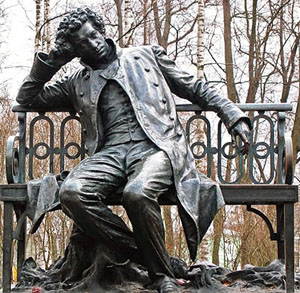
As promised, here’s the second part of David’s excellent post about the only ten neuter Russian nouns that end in -мя. You might, of course, be wondering, why I included this monument to Russia’s beloved poet Aleksander Pushkin in this post. The answer is he used every single one of these 10 little words in his poetry. “Ай да Пушкин!” [Attaboy Pushkin!]. But on with the post…

Meanings and connections of the words

After this digression you couldn’t be blamed if you’ve forgotten the list of «мя» nouns, but now we’ll go through their meanings and their connections, this time in inverse Cyrillic alphabetical order.

«Темя» is given in the dictionary as “crown (of the head)”, “top (of the head)”, “pate” (not to be confused with French pâté). The connection is fairly simple: mutate м to п, drop the я and convert to the Latin alphabet – we get “top”. «Темя» is not used in the plural. [I doubt if it is much used, except by hairdressers, in the singular either].

The English word “pate” might possibly be an example of what I think of as the “Spoonerism” mutation, where two consonants swap places, so “top” becomes “pot” and the vowel changes to become pate. Spoonerisms are so-called after a 19th/20th century Oxford don, The Rev. William Archibald Spooner, who was allegedly prone to accidental switching of consonants, e.g. “A well-boiled icicle” (well-oiled bicycle).

«Стремя» means stirrup. Nowadays not a word in everyday use except by people who are involved with horse-riding, but when Proto-slavic was spoken, the people who knew about stirrups – Asiatic warrior tribes – had a big military advantage over the people who still didn’t – the Europeans. To get from stirrup to «стремя», remove the highlighted i, change the double rr to single r, and mutate p to m. Convert to Cyrillic, add я, and we’re there. «Стремя» is declined normally except for the genitive plural, which is not «стремён», but «стремян».

«Семя» means seed. We can see relationships without needing to mutate anything. Think of words like seminal, inseminate… The Spanish for seed is semilla (Spanish -lla is often pronounced like Russian я). «Семя» is declined normally except for the genitive plural, which is not «семён», but «семян».

«Племя» means tribe. Not very obvious how this word relates to anything familiar, but possibly: mutate the initial п to ф and switch л and м in a Spoonerism mutation, and we end up with something very like family. When populations were very much smaller than today, there probably wasn’t much difference between a tribe and a large extended family.

«Пламя» is quite simple: mutate the initial п to ф and we get something that looks very much like flame, and this is exactly what «пламя» means. In Russian flame is treated as a “substance word” rather than a countable object, so «пламя» isn’t used in the plural. However, «языки пламени» (tongues of flame) can be used to convey the message of more than one flame.

«Имя» [name], is next on the list. This is so commonly used that we don’t really need to look for ways to remember it.

«Знамя» means flag or banner. It is probably the third most common of these «-мя» words, after «имя» and «время». It comes up often in soviet-era song lyrics («красное знамя») Its declension is slightly different from the others in the plural – the infix -ен- becomes -ён- and is stressed, in all the plural cases. Mutate з to s and insert и before н and the first part of the word becomes English sign (the g being silent). Sign comes from Latin signum, meaning sign, mark, emblem. Signum can be mutated completely into знамя (after silencing the g, which was sounded in Latin), so we now have a clear connection.

«Вымя» comes next. An important word for people involved with dairy farming. It means udder. Mutate в to м and change to Latin script, and we can see the link to words such as mammal, mammary, mom (American English)/mum (UK English)/mam (northern UK English). Typically, «вымя» is not used in the plural.

«Время» [time], is so common that we don’t need to look for ways to remember it.

«Бремя» completes the list. It means burden, usually in a rather abstract sense as in “the burden of responsibility”. For a physical burden «ноша» or «груз» is preferred. If we eliminate the u from burden we see that the first two consonants br correspond to the бр of «бремя».

Can we complete the connection by finding a mutation pathway between м and d? D belongs to the t, d, th group. If we mutate it to th we change burden to burthen. The th sound provides a bridge to the p, b, v, f, m group, by mutating to f. In some English dialects “th” as in “thinking about things” is often pronounced as f “finkin’ about fings” or “Fings ain’t wot they used to be”. So now we’ve got from burden to burfen. Mutate the f to m, to get burmen, and now when we get rid of u and insert e between r and m, we see the full connection to «бремя». Although «бремя» isn’t much used, one of its derivatives, the adjective «беременная», is more common. It looks as though it should mean “burdened”, but in fact this is only in a figurative sense. It means pregnant, and it is listed in the dictionary in its feminine form. However the masculine form, «беременный», does exist – it is the title of a film. Can you think of biologically plausible circumstances where «беременный» might be used?

How did these feminine-looking nouns come to be neuter?

To find the answer it’s better to put the question the other way round – how did these neuter nouns come to be feminine-looking? First we need to bear in mind that я is a multitasking letter that, in unstressed positions, can represent other sounds in addition to its principle sound. When unstressed, -я, -е and can all sound very similar. If you’d never read these мя words, but just heard them spoken, you wouldn’t always know what to write for the final letter.

Many of these 10 -мя nouns look very similar in other Slavonic languages, but some of the differences tell us a lot. Here they are in all their variety.


Russian Ukrainian Belarusian. Serbian Bulgarian Polish Czech
бpемя   бяpэмя бpеме бpеме brzemię břemeno
вpемя вpем’я вpемя вpеме вpеме    
вымя вим’я вымя виме виме wymię vemeno
знамя знам’я знaмя знaме знaме    
имя ім’я імя име име imię jméřno
пламя полум’я палымя пламен пламе płomień plamen
племя плeм’я племя племе племе    
семя   семя семе семе   semeno
стремя стремено стрэмя   стреме   třmen
темя   темя   темe    

To see why these words ended up with normal neuter-looking endings in some languages but with –я in others, we need to consider the history of the Slavonic languages.

The modern Slavonic languages are all descended from Proto-slavic, which was spoken up till about 600 CE or later. It was not a written language (not everyone is agreed on this, but even if it was to some extent written down nobody knows how to decifer it). Our ten neuter nouns, in Proto-slavic, all ended with a soft m followed by a nasalized e sound, like the modern Polish ę, so they would be bremię, vremię…etc, and they were declined similar to the way they are today, with the epenthetic n.

By the time Slavonic writings appeared, around the 9th and 10th centuries, Proto-slavic was beginning to separate into different dialects, but not yet so different that Slavic speakers couldn’t all understand each other. Some of these populations were Christianised by the Roman Catholic church, and their versions of Proto-slavic were written in the Latin alphabet, while others were Christianised by the Greek Orthodox church, and their versions of Proto-slavic came to be represented in an early form of Cyrillic by the written language Old Church Slavonic.

By this time the nasalized ę had become denasalized in most dialects. But it was, and remains, still nasalized in the dialect that evolved into Polish. Importantly, it was also still nasalized in the Macedonian dialect on which Old Church Slavonic was based. The nasalised soft e sound was represented in Old Church Slavonic by the letter called «юсъ малый» (unfortunately, the special character doesn’t come through in WordPress, but here’s the link)


As the East Slavonic languages (Russian, Ukrainian and Belarussian) developed, «юсъ» took on the role of representing the я sound. Modern я developed from a handwritten version of «юсъ», and for a while the alphabet contained both «юсъ»  and я. The alphabet was simplified by decree of Peter the Great in 1708, and «юсъ»  was officially discarded, its role being taken over by я. So our ten nouns, that started life as neuter nouns in nasalized –e, ended up as «бpемя», «вpемя», «вымя», «знамя», «имя», «пламя», «племя», «семя», «стремя» and «темя».

At this point you might like to test yourself. Can you match up the above 10 with their English equivalents, which are in alphabetical order: banner, burden, crown, flame, name, seed, stirrup, time, tribe, udder?

Are there any others?

In Russian there are no nouns ending in мя apart from the 10 we’ve discussed. There are a few others that started out as Proto-slavic м + the nasalized e, but didn’t make it into modern Russian as мя neuters either because they evolved differently or they just died out. There were quite a lot of Proto-slavic neuter nouns ending in the nasalized e (without м), but only one of these has made it into modern Russian as a neuter noun ending in –я. This is «дитя» – note that the stress is on я.

«Дитя» is used often in its plural form «дети» (children) but the singular is rarely used, and then only in the nominative. Nowadays the masculine noun «ребёнок» is normally used for child in the singular. This usage is exclusive to Russian. You are likely to encounter the singular «дитя» in the works of classical literature, but also in such phrases as «дитя прогресса» [a child of progress], «дитя века» [a child of the time], «дитя природы» [a child of nature].

Not all proto-slavic nouns that ended in мя  made it to the modern Russian:

«Чисмя» is a word that failed to come into existence. It mutated, acquired a “conventional” neuter ending, and became «число» [number].

Another might have been word is «писмя», but it became a regular neuter, письмо, instead.

So, although there are only 10 Russian nouns ending in мя, and most of them are rarely used, they take us deep into the history of not only Russian but also the other Slavonic languages, and they help us to see why apparent irregularities in other families of words are the way they are.

If you’d like to test yourself:

  • What does a myrmecologist do?
  • What Russian adjective is listed in dictionaries in the –ая form?
  • What masculine noun declines in the singular like a feminine –ь ending noun?

Do you remember David Roberts of the “Million Scarlet Roses” post? He’s back with more and I mean lots more insight into Russian language. And don’t be fooled by the title of the post. You will learn way more than 10 little words. And that’s just in Part 1. So here it goes…

Grammatical gender is not too much of a problem in Russian, because there are simple rules to tell the gender from the ending. So if a noun ends in «а» or «–я» it’s usually feminine, and if it ends in «о» or «–е» it’s neuter. But there’s another group of neuters.

If you’re a native English speaker learning Russian you may have come across a statement in books along the lines: “There are ten neuter nouns ending in «–мя»; the most important of these are «имя» [name] and «время» [time]”. Maybe you’ve wondered “what are the others?” If you’re a native Russian speaker, you may not have known that there are ten of these nouns, you may not be able to list them all immediately, but you almost certainly can recognize all of them and can use all of them easily if the occasion arises.

I think these ten «мя» nouns have a fascinating story to tell, and in this article we will cover:

- what are the other ones besides «время» and «имя»;

- how to remember them by using mutation rules to find relationships with English words;

- how these feminine-looking nouns come to be neuter and not feminine.

While doing all this we will get some glimpses into how Russian relates to other Slavonic languages. We (native English speakers included) may even learn one or two new English words.

Native users of any language have a vocabulary of words that everyone knows and that most people use almost every day. «Имя» and «время» come into that category, so unless you’ve only just started learning Russian, you know those already. But all native speakers have a much wider vocabulary than that: they have a repertoire of words that they may not use or hear for months or even years, but when the need arises, they can understand and use these words without thinking about it.

You can guarantee that during any normal day, talking to people, reading the newspaper, watching television, etc, you will encounter plenty of words in this category – you just can’t predict which ones they will be. For example, «молот» [hammer], «серп» [sickle], «пустыня» [desert] – these days the first two tend to be in the last one; opinions vary as to whether this is a good thing or a bad thing. All of the «мя» nouns except «имя» and «время» fall into this category of always available but rarely used words.

So here they are, in alphabetical order. They all have two syllables, and stress in the singular is always on the first syllable.

  1. Бpемя
  2. Вpемя
  3. Вымя
  4. Знамя
  5. Имя
  6. Пламя
  7. Племя
  8. Семя (not to be confused with «Семья» [family])
  9. Стремя
  10. Темя


Before we go on to the meanings and how to remember them, here’s a reminder of how they decline, illustrated by «племя» (tribe):


Падеж [Case] Единственное число [Singular] Множественное число [Plural]
Именительный [Nominative] племя племена
Родительный [Genitive] племени племён
Дательный [Dative] племени племенам
Винительный [Accusative] племя племена
Творительный [Instrumental] племенем племенами
Предложный [Prepositional] племени племенах

In fact only «время», «имя» and «племя» follow this pattern exactly. But they all have the same pattern in the singular, and they all have the «–ен-» infix for all cases except the nominative and accusative singular.

You may have noticed that in the singular the genitive, dative and prepositional cases, quite apart from the «–ен-» infix, the endings are not what we normally expect for neuter and masculine nouns (genitive «-а» or «–я»; dative «-у» or «–ю»; prepositional «–е»). Normally the genitive ending «–и» indicates a feminine noun. However, in the Proto-slavic times that these nouns date back to the declension system was more complex than in modern Russian, and several groups of masculine and neuter nouns had declension endings similar to the ones above, without the «–ен-» infix. A masculine survivor (maybe the only one) is «путь» [path, way], which declines:


Case Singular Plural
Nominative путь пути
Accusative путь пути
Genitive пути путей
Dative пути путям
Instrumental путём путями
Prepositional пути путях

Remembering words by finding relationships – Mutation rules

Most European languages have evolved over several thousands of years from an ancestral indo-European language. Words can change over time, by small steps that eventually lead to words that look and sound completely different. I find that by trying to find how words in different languages are connected, I remember them more easily. Sometimes there seems to be no connection, and one reason for this is that European languages, particularly Russian and Spanish (which has a large number of words from Arabic), have acquired loan words from contacts with non-European languages.

An example is «карандаш» [pencil], which comes from the Turkic language group. In modern Turkish kara is black and taş (ş is equivalent to ш) is stone. However, I often find that even if the attempt is unsuccessful, the very act of trying to find a connection helps to fix the word in my mind.

No two people pronounce words exactly the same. In an isolated population, one type of pronunciation becomes dominant, and in a different population a different type of pronunciation becomes dominant. For example, the American English and the British English pronunciation of words like “water” and “city” are different. As a result, over the several thousand years that the European languages have been evolving from an original common language, populations that are separated from each other come to speak differently from each other, eventually to the point where the two populations cannot understand each other. By thinking about what sounds can easily mutate into others, we can see relationships that at first glance don’t seem obvious.

We can sort sounds into groups in which they can easily mutate into each other. Take, for example, d and t, plus the two English sounds represented by “th”. We only need to consider consonants – vowels are all easily mutated into each other and can appear and disappear. The word «путь» above is a simple example – mutate «т» to “th”, change the  vowel, and we get “path”. There are several groups of easily mutating consonants, and there are often “bridges” between groups. For our purposes, the two most important groups are:

The “l, r, w” group and the “p, b, v, f, m” group

The “l, r, w” group is fairly obvious – in most oriental languages there is no distinction between l and r, and in Polish the w sound, represented by ł, is treated as a variant of l. The sounds of w and v can easily mutate into each other, so here we have a “bridge” between the “pbvfm” group and the “lrw” group.

The similarity of p, b, v and f is fairly obvious, but m may look a bit surprising at first. However, m interchanging with b and v is a regular mutation in the Welsh language (Welsh, the descendent of the language spoken by the British until about 1500 years ago, has a grammar where the first letter of a word often mutates depending on the word’s role in the sentence – this can make using a dictionary difficult), and another example of this mutation is in the name change of one of India’s major cities – Bombay is now Mumbai. If you’re still not convinced, think about those Russian verbs that insert «л» (only in the first person singular if it’s an и-conjugation verb, throughout if it’s an е-conjugation verb). These are verbs with stems ending in:

«б»любить [love] – люблю, любишь, любит, любим, любите, любят. Notice how the stress is on the –ю ending in the first person singular but is on the stem in all the other forms. This applies to all и-conjugation verbs that insert this «л».

An e-conjugation example is «колебаться» (oscillate, hesitate, waver) – «колеблюсь, колеблешься, колеблется, колеблемся, колеблетесь, колеблются». Notice how the inserted «л» is present throughout the conjugation.

«в» - ставить [put] – ставлю, ставишь, ставит, etc.

«п» - утопить [drown] – утоплю, утопишь, утопит, etc. and спать [sleep] – сплю, спишь, спит, etc.

An e-conjugation example is «трепать» [tousle, dishevel] – треплю, треплешь, треплет, треплем, треплете, треплют

«ф» - графитьграфлю etc. [rule a line on paper] (rather an obscure verb, but verbs with stems ending in ф are rare – in fact ф is one of the least used letters in the Russian alphabet).

«м» - кормить [feed] – кормлю, кормишь, etc.; дремать [doze] – дремлюдремлешь, дремлет, etc.

So no other consonants, but м б в п ф, trigger the so-called epenthetic л. If you want to remember the word epenthetic and its corresponding noun epenthesis, referring to a sound that gets inserted inside a word, think of it as the opposite of parenthetic/parenthesis. Parentheses are put outside of a word, and an epenthetic letter is put inside of a word. The epenthetic л seems to make the –ю and –е sounds easier to pronounce than if they follow м, б в, п, or ф directly, and that is probably how it came to be a regular feature of the language. In some dialects it is not used.

Knowing that м can be inter-mutated with м б в п ф is very useful when looking for connections.

So, to look for relationships between unfamiliar looking words in Russian and words that we know in Western European languages, we play around with swapping p, b, v, f and m, and swapping l, r and w. Here is an example: «муравей».

At first sight this doesn’t look like anything we recognise, but mutate the initial м to ф, mutate в to м, change to the Latin alphabet, and we get fouramey. Get rid of the middle a, modify the other vowels slightly, and we have fourmi, which is French for “ant” (if you don’t know French, you may have heard of formic acid, which is made by ants for chemical warfare). The original proto-European word for ant, whatever it was, must have undergone several mutations over the millennia to end up as modern French fourmi and Russian «муравей».

What about the normal English word “ant”? This is nothing like «муравей» or fourmi, and this is because names were made up for these insects on two occasions, by two different populations already speaking different languages. This is an example of another reason why looking for connections doesn’t always work. “Ant” has Germanic roots, and the original word was related to their being biting insects. The ancestor of «муравей» and fourmi was derived from the smell of an ant nest. Nevertheless, it turns out that there is a connection between «муравей» and an English word – it was just that the English word is so specialised that I’d never heard of it. The word is myrmecology, meaning the study of ants.

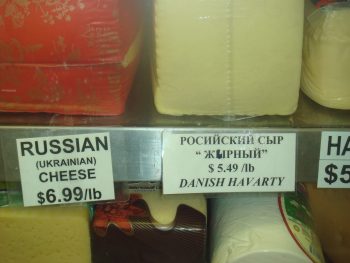
Is Russian grammar confusing? You bet! Just check out this photo I snapped at a Russian store in New Jersey. 

Do you ever get frustrated with Russian grammar rules? Are you tired of declension tables, unpredictable word stress and having to memorize endless exceptions from the rules?

Well, I am not about to offer a magic bullet for your troubles (although this is a post about grammar). However, I do have a great phrase to teach you. When things are confusing and difficult to understand, Russians say «без пол-литра не разберёшься» [lit. can’t figure it out without a half-liter (of vodka)] as in

«Грамматика – дело сложное. Тут без пол-литра не разберёшся» [Grammar is a complicated thing. It’s hard to figure it out.]

Even though I am a native speaker of Russian who paid reasonably good attention in school, I find many grammar rules confusing to say the least. Plus «школа была давно» [school was a long time ago]. Somehow remembering that «жи/ши пиши с буквой и» [write «жи» and «ши» with a letter «и» (even though you tend to hear «ы»)] just isn’t enough to pass for «образованный человек» [an educated person].

For example, I’ve been stumbling over when to use «него», «неё», «них» and when to use «его», «её», «их».

But let’s back up for a minute to review a few Russian «личные местоимения» [personal pronouns], particularly «он» [he], «она» [she], «оно» [it], and «они» [they].

In Russian, pronouns have attributes of

«лицо» [person] – the ones above are all «местоимения третьего лица» [third person pronouns]

«род» [gender] – «мужской» [masculine], «женский» [feminine] and «средний» [neuter]

«число» [number] – «единственное» [singular] and «множественное» [plural]

«падеж» [case] – yes, the pronouns will have different case endings, just like Russian nouns

Here’s a declension table for third person pronouns:


Case

Singular

Plural


Masculine

Feminine

Neuter


Nominative он она оно они
Genitive его её его их
Genitive (w. prep) него неё него них
Dative ему ей ему им
Dative (w. prep) нему ней нему ним
Accusative его её его их
Accusative (w. prep) него неё него них 
Instrumental им ей, ею им ими
Instrumental (w. prep) ним ней, нею ним ними 
Prepositional нём ней нём них

As you can see, this table is just a little bit longer than usual thanks to Genitive (w. prep), Dative (w. prep), Accusative (w. prep) and Instrumental (w. prep) cases.

The “w. prep” means “with preposition”. So now it all seems clear enough – if you use these pronouns with prepositions, you will use a longer form, the one that adds «н» at the beginning of each pronoun. Simple, isn’t it? Why would I ever get confused in the first place?

Ok, as you probably guess, this rule is somewhat incomplete in its explanation of when to append «н» to third person pronouns and when leave them as is…

So here it goes:

While use of «н» at the beginning of these forms of third person pronouns is mandatory with most prepositions, it is downright incorrect with some. But here’s the best part – there are quite a few prepositions with which it can go either way.

Oh, boy… Looks like we need another table, but since Russian language is rich in prepositions and your patience and time are limited, I’m going to skip it (here it is on Gramota.ru)

Here’s what I suggest instead – memorize the following twelve prepositions:

  • благодаря [due to]
  • включая [including]
  • вне [outside]
  • вопреки [against]
  • вслед [following]
  • навстречу [toward]
  • наперекор [against]
  • наподобие [like]
  • подобно [like]
  • посредине [in the middle of]
  • посредством [by way of]
  • согласно [in accordance with]

When you encounter these, you should not use «н» with the third person pronouns. Compare (I capitalized the preposition + pronoun combinations for added emphasis):

«В наше время высшее образование необходимо. Только БЛАГОДАРЯ ЕМУ  вы сможете найти высокооплачиваемую работу» [These days higher education is a necessity. Only with it will you be able to find a high-paying job.]

«В наше время предприимчивым людям нет необходимости в университетском дипломе. Они могут стать миллионерами ВОПРЕКИ отсутствию ЕГО [These days entrepreneurial individuals have no need in university diplomas. They can become millionaires in spite of not having such.]

Now, if you just use «н» in all other cases, you’ll be set.

«Кредитные карточки необходимы. БЕЗ НИХ становится трудно не только покупать дорогие вещи, но и путешествовать» [Credit cards are a necessity. Without them it’s becoming difficult to buy expensive things as well as to travel.]

«Способов избежания долгов много. В ЧИСЛЕ НИХ  - перестать пользоваться кредитными карточками» [There are many ways to avoid debt, including avoiding use of credit cards.]

So, memorize the twelve prepositions and you’ll be speaking «грамотно» [properly]. In fact, not only will you be speaking just as properly as native speakers of Russian, but, in some cases, «даже лучше них» [even better than them].

Which brings me to the last part of this «н» rule:

Whether you use «н» or not in third person pronouns following comparative adjectives is totally up to you (thus saying «даже лучше их» is just as grammatically correct).

Warning – there’s going to be more grammar posts this week. But if there’s any particular grammar topic you’re interested in, let me know.

YouTube Preview Image

Well, «дорогие читатели» [dear readers], I owe you an apology for abandoning you for so long. I was delayed in returning to England and «в результате» [as a result], I had to do extra work to catch up. «Весь день» [All day], I would be reading. However, now I seem to have caught up, so I am back to posting, and I hope the fantastic video in this post makes up for my long absence.

I know we usually try to stay away from politics here on the Russian Blog, but I cannot resist getting just a little bit political today. You see, I found this excellent video on YouTube and I cannot resist sharing it. It is «шутка» [a joke] about «выборы 2012» [the 2012 elections]. Best of all, it is «на русском» [in Russian], so we can learn from the phrases. I have picked out some of my favorite bits so we can analyze them grammatically and learn new vocabulary. They are in order of appearance in the video, but I won’t tell you where they are – you will have to listen and find them. (If there is something that you do not hear in the video even after a few viewings, just let me know in the comments and I will tell you where it is.)

So, you should probably watch the video first. Then, read about these phrases I have selected.

  • «Я думал у нас будет больше времени.» [I thought we were going to have more time.] Notice two grammatical points in this sentence: when saying that you have something in Russian, you typically use «у» plus the genitive case. And «больше» takes the genitive case as well.
  • «Два кандидата» [Two candidates] This phrase demonstrates a rule of quantification in the Russian language: with «два, три, и четыре» [two, three, and four], we use the genitive singular. I do not want to go into these rules too much on this post – if you would like me to post about quantification in Russian, please let me know.
  • «У нас сложился очень эффективный тандем с президентом Медведевым.» [President Medvedev and I have formed a very effective tandem.] I confess, this is a new expression to me. One thing I find interesting is that the imperfective of «сложиться» is «складываться».
  • «Вот это да.» [Wow; Well, how about that.] I actually have a story about this expression. My Russian professor told my class once that he was talking to a family friend’s young son (in Russian) and the child used the English word “Wow.” My professor said that he was teasing the child for not using the Russian version of the saying since, after all, there is a perfectly good expression in Russian.
  • «Предвыборная гонка начинается.» [The electoral race is beginning.] When talking about something that is beginning, you have to use the reflexive form of the verb. But if a person said that he or she was starting something, the verb would not be reflexive.
  • «В ход пойдёт всё.» [Everything comes into play.] A useful little expression, showing how the word order in Russian can be very fluid.
  • «Время пришло [The time has come.] I have not read a specific rule on this, but I have noticed that the verbs of motion usually used with «время» [time] are the ones used for motion on foot.
  • «Выбора нет.» [There is no choice.] This sentence shows how we use the genitive case for negations.

There appears to be a strange little advertisement at the end for «КПРФ» [KPRF (Communist Party of the Russian Federation)]. I am not sure why that is – perhaps the video’s creator supports «Геннадий Зюганов» [Gennady Zyuganov (leader of the Communist Party in Russia)].

Anyway, I hope you enjoyed the video. I think it is completely and utterly brilliant (and very amusing as well).

Comments? Questions? Let me know using the form below!

Back to the Top