


Subtitles: Yes or No? Posted by Anna on Sep 27, 2008 in Culture
There’s been quite a discussion going on among my friends about this plan of TVP2 (one of the Polish TV channels, link sadly in Polish only) to start using Polish subtitles for some of its programming. And it’s about blerry time, I’d say!
You see, while most countries either use subtitles in their native language or dub foreign programs completely, in Poland the set-up is slightly different. There you have one person (normally a guy) reading the lines of all actors in Polish while the original soundtrack is still somewhat audible in the background. So let’s say, you have Dr. House going on one of his usual rants and you can just barely hear Hugh Laurie’s voice muffled by the sound of the Polish reader. Sounds weird? It is!
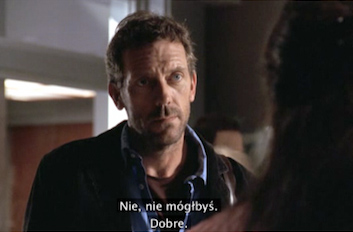 And now TVP2 decided to start showing original English language programming with Polish subtitles. In other words, like it should be. The program selection will be targeted towards teens and the idea behind it is that it should help the kids learn English.
And the reaction of the public? Surprisingly, only 19% of Poles want to have subtitles, the people actually prefer the reader! And they give you a myriad of excuses why the dude reading the lines out loud should stay. They say that it’s impossible for kids to read that fast. Oh really? Then it’s time to learn to read faster. The level of reading skills among Polish youth, and not just youth, is truly atrocious. I myself have several friends who, for all intents and purposes, are functionally illiterate.
The public then says that Polish, being a Slavic language, is too complicated and difficult to translate nicely into coherent subtitles. Oh really, again? Slovakian is a Slavic language too, and somehow those poor Slovaks manage to read their subtitles just fine. The public complains that visually impaired viewers won’t be able to enjoy TV if there’s no one reading the lines. Here, they do have a point, and their concern for their fellow countrymen is really touching. Not like all those heartless Scandinavians for example, who must live in countries where everything on TV, without exception, is only subtitled.
What puzzles me the most is that films shown in Polish movie theaters are subtitled, have been subtitled for ages, and somehow people can read fast enough and nobody sees a reason to complain. But try to stick subtitles on TV and there’s a public outcry. There are opinion polls and studies and expert opinions pretending to prove just how ineffective subtitles would be and how physically impossible for people to read fast and comprehend. (So, my question again, how have they been managing at the movies all those years, huh?)
And then, there are some naysayers who don’t believe that this initiative will help at all with convincing kids to learn English. Maybe not, but don’t you think it’s worth a try? Because isn’t it odd that in places like France, where everything on TV is dubbed, the level of English is what it is. Or rather isn’t. And just the opposite is true in the countries with subtitled TV programming. Coincidence? I don’t think so.
So I say, bring on the subtitles and you’ll see that everybody wins. Kids will start learning English, and the rest of us will be forced to get reacquainted with reading again.
Build vocabulary, practice pronunciation, and more with Transparent Language Online. Available anytime, anywhere, on any device.

Comments:
David Piekarczyk:
Hi,
You can copy the URL plan TVP2 into Google Translate and it will translate the whole page into English.
Michael Farris:
I’m extremely skeptical about this for several reasons.
I’ll focus on three to start with:
1. This will address no unmet need in the country (except maybe encourage people to not watch TVP2). There is no real market desire for compulsory subtitles in Poland. Anyone who’s really interested in subtitles (or not hearing the godawful voice-overs) can get a dvd player and have at it.
Interestingly at the dvd rental place I use the most common question from other customers is “is there Polish audio?” (expressed in a variety of ways, including ‘czy jest dubbing?’ since most Polish people don’t distinguish voice-overs and full dubbing).
2. There’s something deeply creepy about the mentality behind this that thinks that millions of Polish people need to reorganize their lives around learning a foreign language. American tv shows are not educational aids, they’re entertainment and trying to use them for educational purposes is bound to have lots of unforeseen consequences.
3. Subtitles aren’t a good way to learn a language. For technical reasons, subtitles have to leave out about 20 % (at least, often more) of the original content. Good translations will often diverge from the original source material in other ways as well which reduces their propaedeutic effectiveness. Related to this, is the fact that the general level of subtitling in Poland …. isn’t very good. This is not entirely (or even mostly) the fault of translators but it’s another nail in the coffin of the myth that subtitles will help Poland become an English speaking country (and not have to worry about Polish spelling rules anymore).
Grazyna:
The idea with the subtitles is meant well, that’s for sure. The old habits die hard, though, and I can’t imagine all these grannies trying to watch “Bold and Beautiful” or some latin American soaps and having to focus on reading the subtitles rather than following the fascinatingly complicated plot 😉 Perhaps a good compromise would be to provide both subtitles and the interpreter as options that can be either switched on or off?
Anna:
Hi Michael,
As much as I’m a fan of subtitles, I’m also certain this experiment in PL will fail. We’re simply too lazy and too set in the old ways to change. I think that’s why TVP is trying it with their youth-oriented programming, probably hoping that the young ones will be more receptive to new things. Because like Graz pointed out, nobody can expect babcias to read subtitles on Latin soaps, or whatever it is they like to watch these days.
When it comes to the general quality of subtitles, I don’t think it will be that much worse than what is currently being read/dubbed. A lot of the original content is left out right now too. But with the reader muffling the original soundtrack, we’re simply not aware of it. And while I agree that subtitles aren’t a good way to learn a new language, they do help.
Nobody expects Poland to become an English speaking country, but if the kids get used to listening to English on TV and to reading POLISH subtitles, then isn’t it a win-win situation? Who knows, maybe by being forced to read more, even their Polish spelling skills will improve. But wishful thinking…
Incidentally, the same problem can be seen in the US. Many people refuse to watch foreign films, because as one guy put it “I don’t go to the movies to read.”
Thomas Westcott:
Anna,
I am all for subtitles. Why? Because I like opera. I especially like the music, and I like the beautiful costumes, and sets (scenery) and the beautiful and talented people singing but not always the singing. When sung in a different language – sometimes all I hear is noise. And that noise destroys any enjoyment of the music or anything else. But with subtitles I can understand what is going on and because I understand then I can enjoy the music and everything else.
I have watched ‘Battleship Potemkien’, ‘Seven Samuri’, and other foreign films with subtitles. And because of those subtitles I was able to enjoy the films.
For those who say”I don’t go to the movies to read.” I would say that they are missing out on many good films. However, ‘they’ remind me of verse seven from chapter one of Proverbs: “The fear of the Lord is the beginning of knowledge: but fools despise wisdom and instruction.”
Fran Turner:
I have sub-captions available on my TV here in Washington state for most English (er, American?) language programs. I sometimes have a hard time understanding the spoken content in it’s original, so I will turn on the captioning to capture what I cannot understand. Sometimes, tho, the captioning gets in the way of the picture – so off it goes. Educators around here encourage parents to leave the captioning on as it does help the kids (and sometimes the adults) to improve their reading skills. Also, having the captions helps if you are in a very noisy environment (like a “sports bar”). The drawback is that you have to look at the TV constantly. I can attest that watching a film in a foreign language with sub-titles does help to learn the language as it is a technique that I use. However, that is my intent. My husband watching the same film with the same sub-titles does not get this side benefit as he is not interested in learning the language(s). I agree with Grazyna that providing the options is probably the best way to please most of the people most of the time.
Anna:
Hi Fran,
I agree, having both options would be ideal, unfortunately somehow I don’t think it will be possible in Poland, simply because of the sheer cost involved.
Thomas,
Opera, you say? When watching any opera, subtitles are ESSENTIAL! Even when it’s sung in a language I’m supposed to know, I still find it hard to understand. And your quote sums up nicely how I feel about people stuck in their old ways and afraid of learning something new. Thank you for sharing!
michael farris:
Just to clarify, my personal preference is for subtitles whenever possible but I’m a language geek so my tastes aren’t necessarily everybody else’s.
Strangely I usually don’t mind real dubbing which does have some advantages over both subtitles and voice-overs (it allows for the most complete translation as little to no info has to be discarded for time constraints). I’ve been watching the Simpsons dubbed (finally) into Polish and enjoying it well enough (despite some rough patches which woulnd’t necessarily be any better with subtitles or lektor). In a show with _dense_ and rapidfire dialogue subtitles (or lectors) just don’t work.
Also, strangely enough, I enjoyed Friends dubbed into Polish far more than I ever enjoyed the original.
But (getting to my point) I don’t think my personal preference should take precedence over general market preferences.
And in Poland the market choice is audio translation in the form of (ugghh) … voice-over. It also means that I don’t watch much Polish tv because a voice over translation ruins a movie for viewers whose first language is the same as the original language of the movie. I can stand to watch a non-English language movie with a lector but it’s just awful with American stuff.
And sub-titles can aid in language learning when used right. But just watching a show with subtitles in real time and forgetting about it afterward is not using it right.
Actually what I _would_ support is selected programs (not just English-language ones) shown with subtitles of the original language (but complete dialogue whenever possible and not the abbreviated versions that are usually employed). That is much more conducive to language learning.
Alternately, show the program with Polish and English (or whatever) titles and then go over selected parts with a qualified lecturer who can elaborate on linguistic or cultural points of interest.
Esa:
Just a brief comment on this.
Researches estimate that tv’s subtitles do have a positive effect on a child’s reading abilities. Expecially in the early phases of learning.
PISA (Programme for International Student Assessment) research shows that children living in countries where the sub-tit.es are used, have better reading abilities than average (in OECD countries). And also the other way around..
Well, this only as a fact..
Karen:
I agree whole heartedly with this article. The reason why the Dutch are so excellent at speaking English and other languages is because almost all their TV is subtitled. They have a lot of British & US shows, which is why they tend to learn English as their first foreign language. Similarly goes for the Belgians, where a lot of TV is subtitled in both French and Flemish to save arguments as to what language to dub it into!
The French people tend to dub films, as do the British, so we and they don’t tend to learn Foreign languages so well, because we just don’t hear them! I think I’m pretty good at several languages, but only because I grew up in Belgium and lived there until I was 19, so I had a good all-round exposure, and learned Polish at home from my Grandfather until I was about 14. 🙂
By the way, do you know much about the different kinds of spoken Polish? I’ve been accused of speaking “old” Polish when I’ve been to Poland on holiday. It would be like someone coming to the UK and saying “thou art a nice person” I guess?
Jabulani:
I can’t wait for the subtitles to come to my South African TV. People will just have to make do with it, it makes no sense that this society has not embraced this no feature of technology.
I care less what any expert wants to tell me about it not being of any or little benefit to the hearing impaired, I say let me be the judge!
It’s damn crazy what all this ‘under-the-rock’ experts all of a sudden creap out with. These and many societies need to graduate, the so deemed ‘normal beings’ are not the only ones making up this society.
Viva Subtitles!
Jan:
I object to the statement that connects subtitles to the English language only or does Polish TV have so liitle variation that there is nothing from Germany, France, Sweden or Russia on TV ?
Johan:
I also agree whole heartedly with this article. And there is an additional reason why:
A crucial part of an actor’s or actress’ performance is how he or she uses his voice; expresses emotions etc. This is an essential part of the movie experience. Otherwise we’d stil have silent movies.
So when the Germans or the French dubb their movies – not to mention the Poles having their ghastly Polski lektor – it is a crime against culture. It is a crime against the performances of actors and actresses world wide, no matter their native language. It shows contempt towards their craft and their talent.
What would for example a Japanese samurai movie be without being able to listen to the actors speaking Japanese in that unique tone of voice?
Personally I would not accept into EU a single country that dubbs its TV programs or foreign movies, due to the contempt shown towards the art of acting and the original performers.
Yo:
Do not tell me that you learn your native Polish language after you already finished the school. If it is like that…you have a problem. I am Romanian leaving in Poland and I can read the subtitles in English but do not understand your language because is too complicated and even the Poles cannot speak corectly. I think that this people are too lazy to read and yes…it is the time to learn a foreign language and do not hide behind patriotism.
Nunio:
Hi,
I buy the dvd of one of my all time best movies the other day, to find that by some reason, it was the polish edit version of the dvd, with only polish lektor over the original sound, deafing the music of the whole movie, and so on… i get so frustrated and horrorized, that later i find myself thinking of why this kind of cheap thing can have succes in a country, over using subtittles in their own language…
Like a rational game, i find sadly that the most rational answer can only be some kind of:…
The 80% of the population dont know how to read their own language, but they really like to watch foreign movies & tv shows.
And this only can be the logical progression from the radio old days, when some reader was reading books for the joy of the uneducated radio listeners.
And this hipotetical country dont care about music…
Tomos Burton:
S4C would never subtitle English programmes in Welsh. You have subtitles for the people that want to learn languages and dubbing to adequately translate it into the local culture. You absolutely have to have both. If shows weren’t dubbed there’d be no version of the theme song in that language and therefore less options and less material to learn the language with. When you dub something you’re creating a new programme. Although Gavrilov translation is a bit stupid, I’ll give you that.
You could always have subtitles on the dubbed version.