Logo
McAfee Secure sites help keep you safe from identity theft, credit card fraud, spyware, spam, viruses and online scams
Contact Us Customer Service Tech Support
Learn Irish Language
Irish Learning
About Irish
Irish Products
Games
Quizzes
Resources
Learn Irish with Free Software Downloads

Mailing List


Exclusive offers.
Product highlights.
Language updates.
Join our mailng list today!


Overview of the Irish Language

The Gaelic language is divided into two distinct varieties: Irish Gaelic and Scottish Gaelic. Irish Gaelic is more commonly just called "Irish". It is a Celtic language that is part of the Indo-European language family.

Written Irish was based at first on Latin orthography and British pronunciation, which makes ancient texts difficult to decipher. Viking invasions in 8th century Ireland left their mark on Irish vocabulary by introducing Scandinavian words that refer to navigation and urban life.

Up until the 17th century, the Irish language was spoken by the entire population of Ireland. It was predicted that Irish would become extinct in the 19th century due to the influence of English. However, the language experienced a resurgence after the formation of the Irish Free State in 1921. A standard written form of the Irish language was implemented in 1945.

Today, about 500,000 people speak Irish, which adds up to about one-seventh of the population of the Republic of Ireland. Irish Gaelic is the official language of Ireland, but it has been overtaken by English as the primary spoken language. Because of this, the government has instigated revival programs. The Irish language is now taught in all of the schools in Ireland. Dialects of Irish are prominent in the following areas: Munster, Connacht, Donegal, Leinster, and Ulster.

The Irish Alphabet and Irish Vocabulary

The Irish alphabet has only 18 letters, as compared to the 26 in English. The remaining letters, such as "j" and "z," may be used in loanwords from other languages, but are not used in native Irish vocabulary words.

English words of Gaelic origin include bard, glen, bog, whiskey, shamrock, and galore.

When you're learning Irish vocabulary, watch out for false cognates. These are vocabulary words that resemble English words but have a very different meaning. If you are learning to speak Irish and you ask someone for a bean, you may be surprised to find out you requested a woman! The phrase "Have no fear!" might get you in trouble, fear means man! If you tell someone they are bád, you're calling them a boat!

Irish Grammar and Irish Pronunciation

Unlike English, Irish nouns, adjectives, pronouns, and articles have a gender assigned to them. To complicate matters, the gender of Irish nouns does not always seem logical. For example, cailín (girl) is a masculine noun, whereas bean (woman) is a feminine noun.

Learning Irish pronunciation can be tricky for English speakers because the words are not pronounced phonetically. Some words are particularly baffling. Teamhair (hill) is pronounced "t'yower"; niamh (brilliance) is pronounced "nee-av"; and suidhe (sit) is pronounced "see."

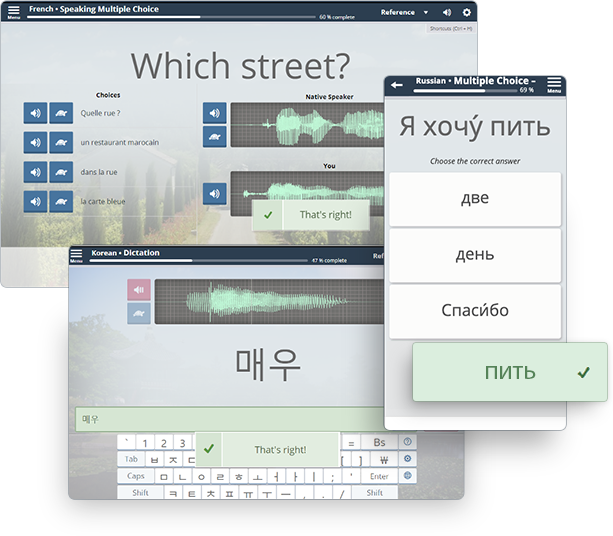
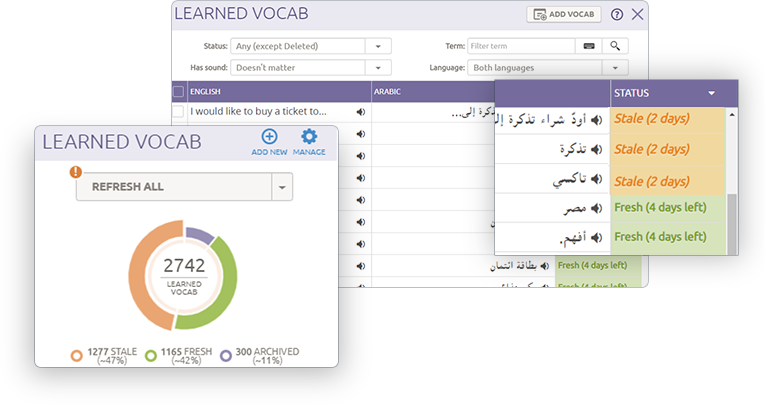
Regular practice is necessary to learn to speak Irish well. That's one reason why good Irish software programs can be so useful for Irish language learning. It's easier than ever to learn Irish and to begin to speak Irish with the language resources and Irish language software from Transparent Language. With IrishNow!, Before You Know It, and our other language learning products, you will speak Irish, learn Irish vocabulary, conjugate Irish verbs, understand Irish grammar, and master Irish pronunciation quickly. Best of luck with your Irish language learning!

Irish Byki Deluxe


Home | About | Products | Languages | Store | Partners | Contact Us | Customer Service | Technical Support

If you have comments about this language learning site, language software, or ways to learn languages, please contact us.
©2009 Transparent Language. All Rights Reserved. www.transparent.com
Please also visit our language websites:
Arabic | Chinese | Dutch | French | German| Hebrew | Italian | Japanese | Learn Latin | Polish | Portuguese | Russian | Spanish | Swedish